Wasps in California can cause costly problems when early signs are missed. Learn the signs, risks, and when to call Official Pest Prevention.
Wasps in California: What You Need to Know
Yes, California is home to several wasp species that homeowners may encounter around their property. Wasps can nest in sheltered areas like eaves, attics, trees, and wall voids, drawn by food sources, water, and spots with minimal disturbance. Understanding which wasps you might see, the risks they pose, and how to respond can help you make informed decisions about your home.
This guide covers how to tell different wasp types apart, what makes them a concern near your home, and steps that can reduce nesting activity around your property. Wasps and hornets can be territorial, and their stings can cause allergic reactions, so knowing when professional help is warranted matters. We also explain why DIY nest removal is not recommended and what a professional approach looks like.
Whether you have noticed a single wasp near your roofline or a nest forming in a high-traffic area, the sections ahead give you the practical details you need.
How to Identify California Wasps
California is home to several wasp species, and telling them apart starts with looking at body shape and nest style. Some species are social and build shared nests, while others are solitary and construct individual nests. Knowing what to look for helps you decide whether a nest near your home needs attention.
How to Tell Wasp Types Apart in California
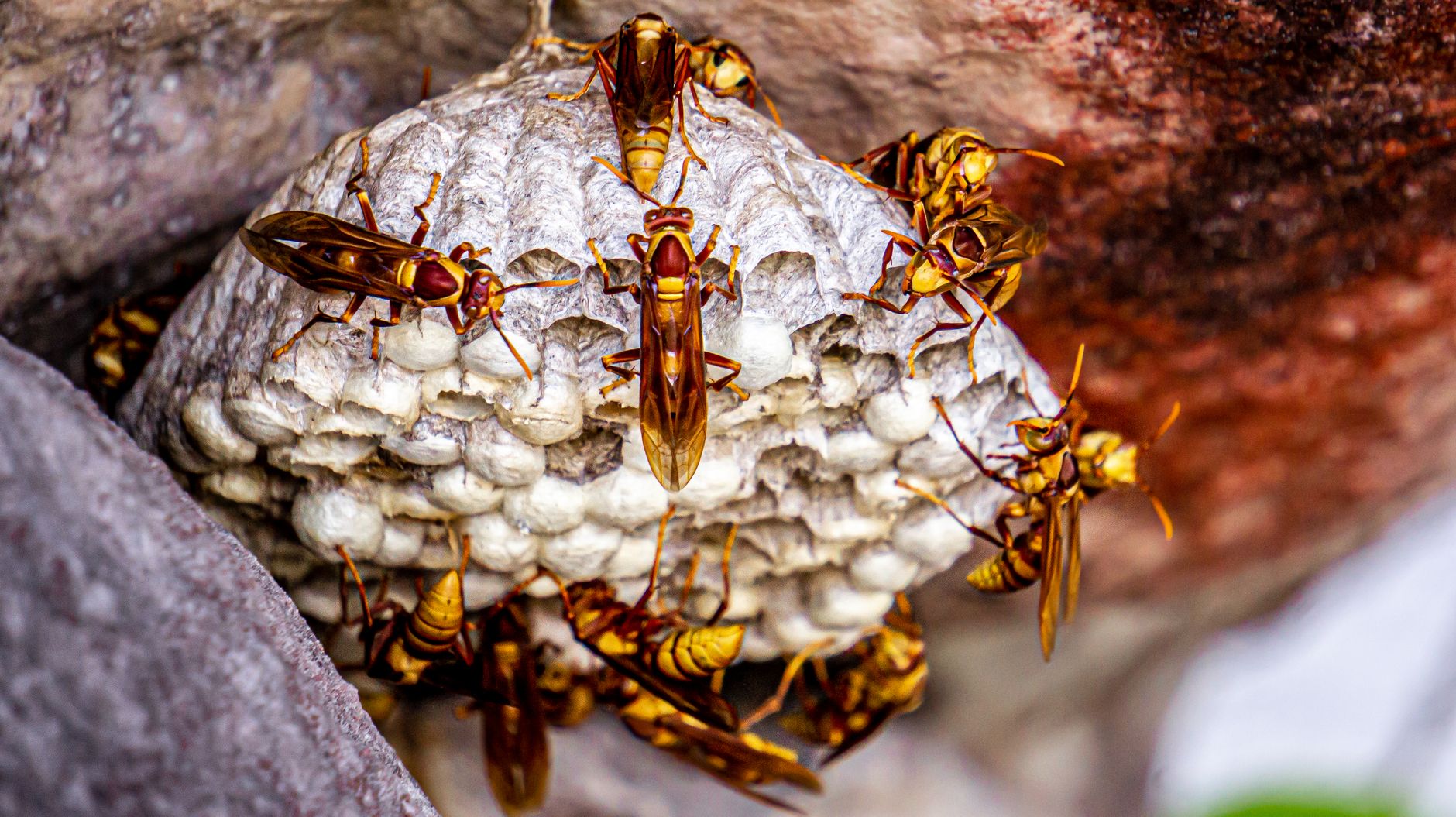
Paper wasps are among the most recognized wasp species. They have slender bodies and build open, papery nests that last only one season, according to Mississippi State University Extension. Their nests hang from a single stalk and are easy to spot under sheltered surfaces.
The baldfaced hornet is a large black and white species that builds a familiar grayish, pear-shaped nest. This nest is typically suspended in trees or on the sides of buildings, and a thick paper envelope encloses horizontally arranged combs inside. Baldfaced hornets are a social wasp species that can be defensive near their nests. If you notice a large pear-shaped nest on your property, keep your distance and contact a professional for removal.
Mud daubers look different. As Purdue Extension describes, these solitary wasps are long and slender with a prominent thread-like waist. Their nests are made of mud rather than paper, making them easy to distinguish from social wasp species.
How to Spot Wasp Activity Inside Your California Home
Wasps sometimes find their way indoors through gaps around your home. You may notice a single wasp flying near windows or ceilings. If you see repeated activity in the same area, a nest may be forming nearby. Even a lone wasp returning to the same spot can signal nesting, since some solitary species lay eggs in small cavities.
Where Wasp Activity Shows Up Around California Homes
Eaves are one of the most common areas where wasp nests appear. Paper wasp nests built near doorways, walkways, or seating areas are more likely to lead to stings and may need early treatment. Nests that are not near people generally do not require treatment.
Baldfaced hornet nests often hang from trees or the sides of buildings. Mud daubers build small mud nests on the sides of buildings, rafters of open structures, and similar sheltered sites.
Exterior Entry Points Wasps Use Around California Homes
Sheltered spots under roof overhangs, along rafters, and near gaps where walls meet the roofline are common choices for nesting wasps. These locations offer protection from wind and rain. Addressing nest activity early, especially in high-traffic areas, helps reduce the chance of stings during warmer months.
Why Wasp Problems Develop in California
Wasps are drawn to California homes by a combination of sheltered nesting spots, accessible food sources, and the seasonal cycle of colony growth. Understanding what attracts them can help you recognize trouble early and avoid unexpected encounters near your home.
Outdoor Nesting Areas for Wasps Around California Homes
Social wasps build colonies associated with elaborate nests, and many individuals can be active at the nest entrance at any given time. Paper wasps form small colonies around a single exposed nest comb that typically hangs from eaves or inside outbuildings. Solitary wasps, by contrast, occupy individual nests or burrows with only one occupant each.
Social wasp colonies are annual, meaning a nest is used only during the season it is built. Each colony consists of an egg-laying queen and many sterile female workers. As the colony grows through warmer months, activity around the nest entrance increases.
Food and Shelter That Attract Wasps Around California Homes
Warm weather and access to standing water or sugary substances draw wasps toward residential areas. According to UC IPM, reducing available food sources around your property is one practical step toward preventing stings.
How Wasps Move Around California Homes
As colonies grow, foraging workers range farther from the nest in search of food. Some yellow jacket species can become aggressive during late summer and fall and may sting unprovoked. This seasonal shift often creates unexpected encounters and can lead to an increase in stings.
Paper wasps are relatively nonaggressive and serve as beneficial caterpillar predators. However, even these smaller colonies can pose a stinging threat when nests form in high-traffic areas around your home.
Trails and Entry Points Wasps Use in California
Social wasps sting to defend their colony, so any spot where their flight path crosses yours becomes a concern. Nests can form at heights that make them hard to spot until the colony is well established.
Keeping an eye on eaves, outbuildings, and sheltered overhangs during warmer months helps you notice new colonies before they grow large enough to create repeated close encounters.
Risks From California Wasps
Not every wasp in California poses the same level of risk. Social species such as yellow jackets and paper wasps are more likely to sting near homes, while solitary wasps rarely interact with people at all. Understanding those differences helps you decide when a nest near your property needs attention.
Health Risks Linked to California Wasps
Yellow jackets, paper wasps, and similar social wasps can sting more than once because they pull out their stinger without injuring themselves, according to the University of Minnesota Extension. That means a single encounter can result in multiple stings, especially if you accidentally disturb a nest or come too close to foraging wasps.
Social wasps will defend a colony located near areas of human activity, which raises the probability of stings when nests sit on or around structures where people spend time.
Property Damage From Wasps in California
When social wasp colonies grow in structural locations, removing them becomes more difficult and the chance of stings increases. As Purdue Extension notes, destruction of colonies is warranted when they are located in or around structures and areas of human activity where stings can occur.
Mud daubers, by contrast, build small, hard mud nests and rarely sting. Their nests may be unsightly on exterior walls, but these solitary wasps generally do not pose the same level of concern as social species.
Food Areas and Wasp Activity in California Homes
Wasps are drawn to sugary substances, protein sources, and standing water. Outdoor eating areas can attract foraging wasps, and a sting is more likely when wasps are disturbed during that search for food. Keeping these areas tidy reduces close encounters.
When to Look Closer at Wasp Activity in California
Some wasps do not aggressively defend their nests the way yellow jackets do; however, they can still sting if provoked. When these less aggressive species nest away from where you spend time, they can actually be considered beneficial and controls may not be needed, as Purdue Extension explains.
Solitary wasps seldom sting people because they do not defend a nest the way social species do. If you notice a nest forming near high-traffic areas of your home, keeping your distance and having it assessed by a professional is the safest approach.
Professional Pest Control for Wasps in California
When wasps build nests around your home, the location and size of the colony determine whether you can manage the situation yourself or need professional help. Above-ground nests, structural colonies, and late-season populations can pose real challenges for homeowners trying to handle removal on their own.
How to Reduce Attractants for Wasps in California
Reducing food, water, and sheltered nesting opportunities around your property helps make your home less appealing to wasps. Keeping outdoor eating areas clean, covering trash, and removing standing water are practical steps. Regularly checking sheltered spots can help you spot early nest-building activity before colonies grow.
Why Wasp Control in California Starts With Inspection
Colonies can be large and are often located far from the entrance hole, deep into a structure. According to Purdue Extension, control of such colonies is best left to a professional pest control operator. Without an inspection that covers eaves, wall voids, and ground-level entry points, it is easy to miss the actual nest location and underestimate the colony’s reach.
At Official Pest Prevention, we start with a free phone consultation to identify the pest. This step matters because yellowjackets commonly build their nests in the ground, but some species also nest in wall voids, ceilings, or aerial locations, while other wasps nest in eaves or wall voids. Proper identification guides the right approach and helps avoid disturbing protected species like honey bees, which we do not treat.
What to Expect During Professional Wasp Treatment in California
Late summer colonies may consist of nearly a thousand workers, and protective gear along with quick, efficient application is imperative, according to Purdue Extension. Our technicians wear bee suits for protection during treatment. We use Waspfreeze or Bifen and can treat eaves up to 20 feet when needed.
Trapping or nest treatment can reduce yellowjacket populations around your property. Homeowners should avoid disturbing nests on their own, as doing so can provoke aggressive behavior and lead to multiple stings. Africanized bees may also be present, adding further risk. Our technicians are equipped to handle these situations during an initial service visit.
What to Expect From a California Wasp Control Plan
After the initial treatment, roughly half of our customers choose a consistent treatment plan to keep wasps and hornets away for the entire season. This ongoing approach helps address new nest activity through the warmer months, when wasp populations are most active from April to September.
Most nests should be left alone when they are not near high-traffic areas. However, when a nest is close to where you and your family spend time, professional removal ensures proper identification and compliance with local wildlife regulations. As UC IPM notes, homeowners can also check whether their local Mosquito and Vector Control District treats nests.
Bottom Line on Wasps in California
Yes, wasps are present in California, and homeowners may encounter them around eaves, outdoor gathering areas, and other sheltered spots on their property. While some wasps can be beneficial because they feed on other insects, nests located near your home can pose a stinging risk that warrants professional attention. Large or hard-to-reach colonies are best handled by a trained pest technician rather than through DIY removal.
If you notice wasp activity around your home, contact Official Pest Prevention for a free phone consultation to identify the pest and discuss a plan that fits your situation.
Frequently Asked Questions About Wasps in California
Why Are Wasps Nesting Around My Home?
Wasps seek sheltered nesting spots near food and water. Eaves, attics, trees, and wall voids offer the protection and minimal disturbance they prefer. Reducing these attractants can help discourage nesting.
Can I Remove a Wasp Nest Myself?
DIY nest removal is not recommended. Disturbing a nest can provoke stinging, and colonies may be large and located deep within a structure, far from the visible entrance. Professional removal ensures safer handling and proper identification.
Are Wasps Dangerous to People?
Wasps can sting, and some species are more territorial than others. Certain wasps may fly several feet to sting someone near their nest. Their stings can cause allergic reactions, and large nests in high-traffic areas raise the risk of an encounter. Avoiding wasps and removing nearby food sources can help reduce the chance of stings.
What Should I Do If I See a Nest Forming?
Avoid disturbing the nest and keep people and pets at a low-risk distance. Reach out to a pest professional for an assessment. Addressing a nest while it is still small is generally easier than waiting until the colony grows, since late-season colonies can include many workers.
Our methodology: how we research pest control topics
Every Official Pest Prevention article follows the same standard we hold our service work to: clear, accurate, and grounded in what actually works on a real Northern California home. Homeowners across the Sacramento metro and Bay Area communities count on us for honest pest information they can act on, and we treat the writing the same way.
We build our content from a combination of government guidance, peer-reviewed research, and the patterns our technicians see across thousands of homes in our service area. Here is how we approach each article:
Studying pest behavior
We start with how each pest actually lives — where it nests, how it spreads, and what conditions support it. Northern California’s seasonal rain and dry cycles change pest pressure in ways that matter for treatment, and getting the biology right is what tells us what will and will not work.
Reviewing health and home risks
We review research on how each pest affects human health and home structures. Some pests are a nuisance. Others trigger allergies, carry bacteria, or cause structural damage. Knowing the actual risk helps homeowners decide how urgently to act.
Using Integrated Pest Management
Our recommendations are grounded in Integrated Pest Management (IPM), the framework supported by the USDA and EPA. IPM combines monitoring, sanitation, exclusion, and targeted treatment to reduce pest populations while limiting unnecessary product use.
Prioritizing prevention and lasting protection
A pest problem rarely ends with one treatment. We focus on the conditions that allow infestations to start in the first place — moisture, food sources, gaps around the home, harborage zones — because long-term control depends on changing the environment, not just treating the symptoms.
Citing peer-reviewed and government sources
Whenever possible, we support our recommendations with peer-reviewed studies, university extension research, and guidance from agencies like the EPA, CDC, and USDA. Each source we cite is listed at the end of the article.
Why trust us
Official Pest Prevention is a local company with local technicians and local customer support. We serve homeowners across the Sacramento metro and into the Bay Area — Fresno, Elk Grove, West Sacramento, Yuba City, Stockton, Modesto, Pleasanton, Livermore, Hayward, and Fremont. When you call, you reach our team. When a technician shows up, they live and work in your area.
That same standard runs through our content. The information you read here reflects what our technicians see in the field, what current research supports, and what we have learned from servicing homes across our Northern California footprint.
Our credentials
- Service across the Sacramento metro and Bay Area — Fresno, Elk Grove, West Sacramento, Yuba City, Stockton, Modesto, Pleasanton, Livermore, Hayward, and Fremont
- Local technicians and local customer support
- Specialty services including dewebbing and power sprayer treatments
- General pest control, mosquito, rodent, termite, and seasonal pest programs
- Continuous review of research, regulations, and California-specific pest pressure
Sources and standards we reference
To keep our content accurate and up to date, we rely on established research and authority sources, including:
Environmental Protection Agency (EPA):
Guidelines on product use, labeling, and approved applications.
Centers for Disease Control and Prevention (CDC):
Public-health guidance on pests that affect human health, including mosquitoes, ticks, rodents, and cockroaches.
United States Department of Agriculture (USDA):
Integrated Pest Management standards and pest biology research.
National Pest Management Association (NPMA):
Industry standards, pest behavior research, and seasonal trend reporting.
University of California Cooperative Extension:
Peer-reviewed, region-specific research on Northern California pest biology and control methods.
Peer-reviewed journals:
Research published in entomology, public health, and environmental science journals to support specific claims about pest behavior, health risks, and treatment efficacy.
Article sources
The following sources were specifically referenced in the research and development of this article:
- Mississippi State University Extension
- Purdue Extension
- UC IPM
- University of Minnesota Extension
- Purdue Extension
All information is accurate at the time of publication and is reviewed regularly to reflect current research and pest control standards.